
“Give up and die.”
That was a medical professional’s actual answer when I asked what he’d do next. (Ummmm, NO THANKS.)
To be fair to him — barely — by that point my chart was a mess of contradictions. For years, my body had opinions I couldn’t decode: severe GI pain and bloating to the point of gastroparesis. Random rashes. Joint and muscle aches I couldn’t pin to anything, brain fog, crushing fatigue, anxiety, headaches, palpitations. Allergy tests: negative. Standard advice: unhelpful. An elimination diet (I went full AIP for several months) helped me determine I was definitely gluten- and nightshade-intolerant, and removing those from my diet helped – but I still struggled. Antihistamines, digestive enzymes, supplements upon supplements, even energy healers – you name it, I tried it.
The pattern hiding underneath: it was never really about which food. It was about the food plus time, plus stress, plus hormones, plus whatever else had already filled the bucket that day. Which is why it seemed random. It wasn’t random — it was cumulative.
The moment it clicked
Perimenopause is a whole bucket of insanity, let me tell you. All my symptoms escalated, and not slowly. So I started digging. Histamine had come up as a possible issue in my research previously, but frankly, it was too intimidating an issue to seriously consider. However, while researching nutrition and diet information for mom’s weird health stuff and impending surgery recovery, I revisited my genetic results from years ago. Remember 23andMe? I still had the raw data – and I dug into it with fresh eyes.
Lo and behold, I had some… quirks.
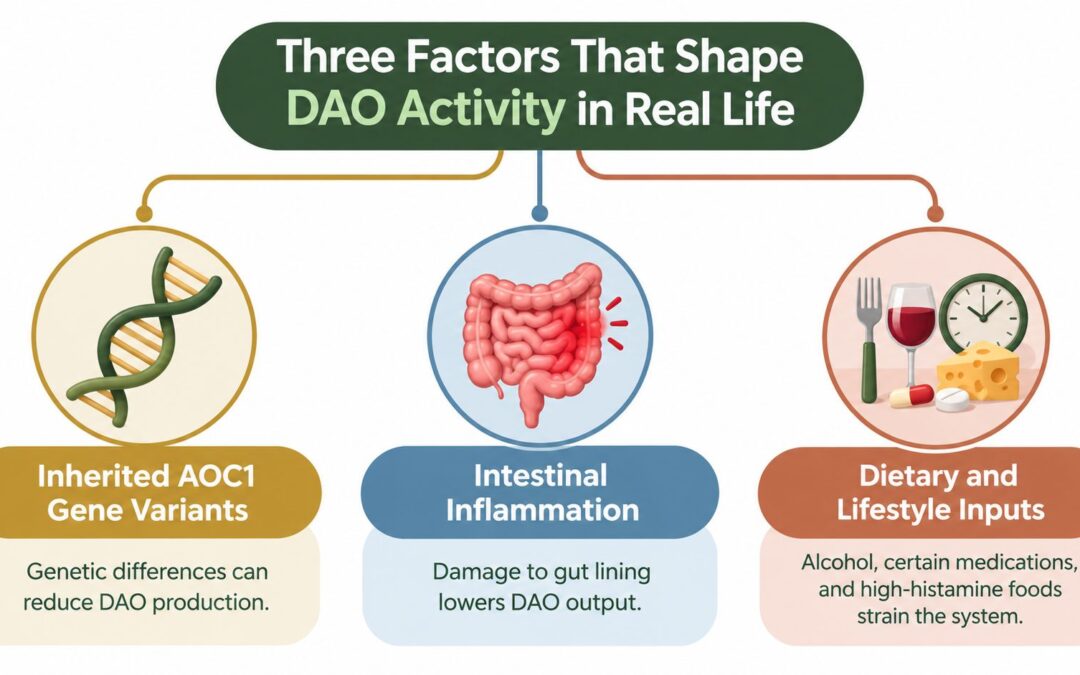
The quirk in question: I genetically pretty much don’t produce Diamine Oxidase, or DAO – the enzyme that breaks down dietary histamine.
The phrase for what I was experiencing: histamine intolerance. Not an allergy — my body was producing or eating more histamine than it could break down, and the overflow was showing up everywhere. The full explainer is here: What Is Histamine Intolerance, Actually? — but the short version is that histamine builds in food over time, and my bucket was filling faster than it drained.
Suddenly a decade of nonsense made sense. The leftovers that “should” have been fine. The aged cheese incident. The reason tuna and lunchmeat sandwiches made my stomach cramp so badly. The wine flush. The fact that I felt mysteriously better on days I cooked fresh and worse on weeks I relied on meal prep or ate out like a normal person.
What changed (and what didn’t)
The honest part: a diagnosis — even a working hypothesis with this much explanatory power — doesn’t fix anything by itself. What it gave me (after the initial panic and subsequent depression) was a rulebook. Histamine is a time-and-temperature problem. So I built a system around time and temperature: cook fresh, freeze fast, portion small. That system became the Cube Method, and eventually a whole cookbook, because it turns out a lot of us are out here doing freshness math alone in our kitchens.
What didn’t change: I’m still me. I still have low-energy days, an AuDHD brain, perimenopause stirring the pot, and a household running three different restricted diets at one table — mine, my partner’s (no plants, not even a fleck of garnish), and my mom’s (no-chew, gluten- and dairy-allergic, MCAS). The system had to work inside that reality, or it wasn’t a system at all.
If you’re in the mystery phase
Some things I wish someone had told me earlier:
- “Random” reactions usually aren’t. Start a simple food + symptom + timing log. Two weeks of notes taught me more than two years of guessing.
- Freshness is a variable. Before you eliminate a food forever, check whether it was fresh-cooked or day-three leftovers. Sometimes the food is fine and the age is the problem.
- Your tolerance moves. Stress, sleep, illness, and hormones all change your bucket size. A bad day isn’t failure; it’s data.
- You don’t have to figure this out alone. Work with a provider if you can — rule out the look-alikes. And borrow systems from people further down the road. That’s what this site is for.
Where I’m at now
Still testing. Still occasionally humbled by a food I thought I’d made peace with. But I have a freezer full of labeled cubes, a kitchen that works with my body instead of against it, and — for the first time in years — the ability to answer “what’s for dinner?” without dread.
If you’re at the beginning of this: it gets so much better. Start with one rule — cook fresh, freeze fast — and let the system grow from there.
Not medical advice — my story, not your diagnosis. Please work with your own care team.